
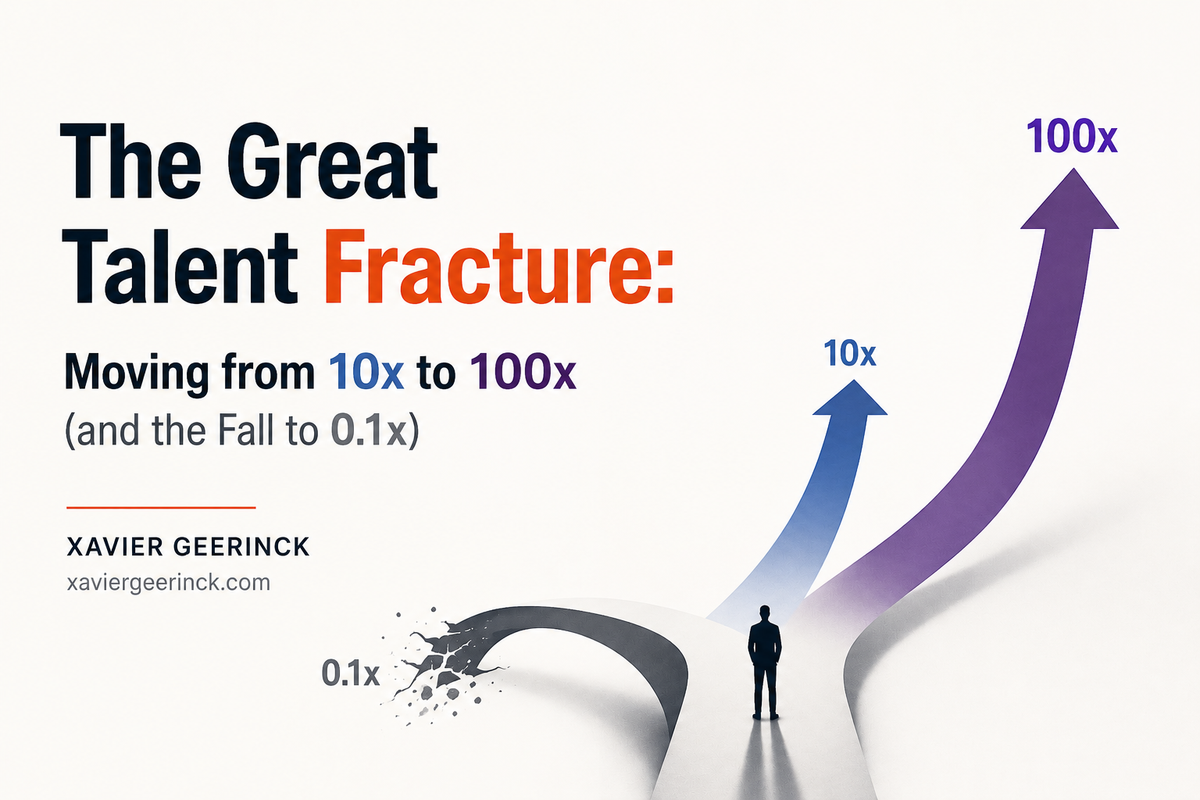
The Great Talent Fracture: Moving from 10x to 100x (and the Fall to 0.1x)
The AI boom isn’t leveling tech talent—it’s fracturing it. The middle is evaporating as average developers collapse into 0.1x rubber-stampers, while seasoned distinguished architects amplify into 100x engineering forces. The future belongs to deep architectural taste and first-principles debugging.
The tech industry loves a good linear narrative. For decades, we believed that tools level the playing field. We assumed that the rise of LLMs and autonomous coding agents would democratize engineering, lifting the floor so that anyone could ship production-grade software.
It was a comforting theory. It’s also completely wrong.
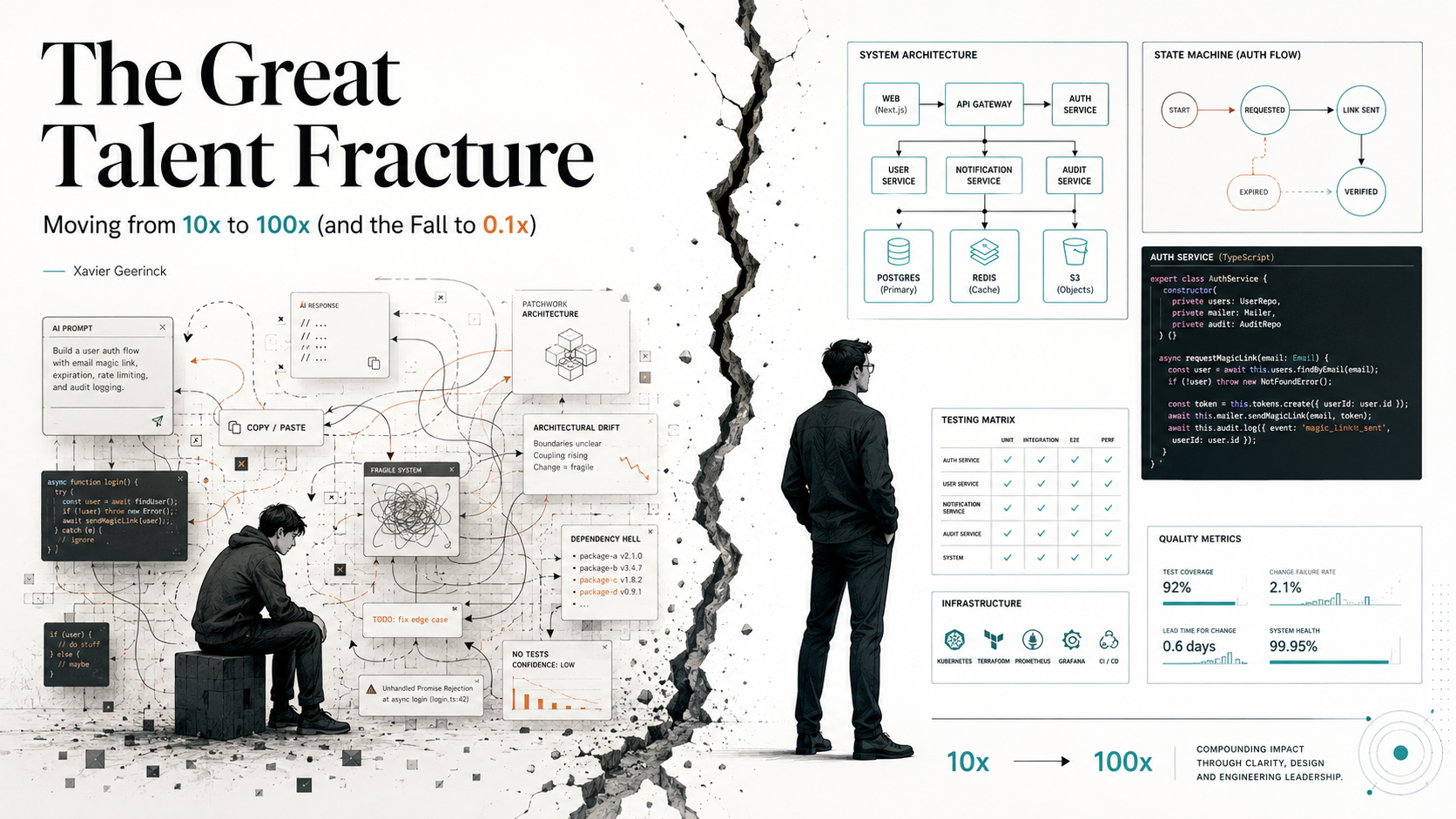
What we are actually witnessing in production environment development isn’t a rising tide; it’s a violent, asymmetric split in the talent distribution. The middle is evaporating. The traditional 1x engineer is rapidly collapsing into a 0.1x rubber-stamper, while the seasoned 10x engineer is amplifying into a 100x sovereign technical force.
This isn't about productivity hype. It’s an architectural reality driven by how human cognition interacts with stochastic code generation.
The Downward Spiral: Why 1x Becomes 0.1x
The average engineer views generative AI as a shortcut to bypass the friction of learning. They see a prompt box and think they’ve been freed from reading documentation, understanding lifecycle hooks, or tracing network payloads.
"I’ve watched this play out in real-life: engineers now open their LLM tool of choice, dump in a vague requirement, and just hit enter. Then they blindly accept the output, hit enter again, and repeat the cycle. They aren't consuming context. They aren't thinking critically about how the system should actually behave. They’ve replaced engineering with a high-speed game of copy-paste telephone."
This creates a subtle, dangerous feedback loop:
- The Context Amnesia: An engineer prompts an LLM for a quick component or a backend route. The model spits out 50 lines of plausible-looking code. The engineer copies it, pastes it, and it compiles.
- The Atrophy of Critical Thinking: Because the engineer didn't build the mental model of how that code operates within the broader distributed system, they cannot spot the edge cases. They miss the unhandled promise rejection, the silent race condition, or the unoptimized database query hidden under an abstraction layer.
- The Debt Explosion: When the application inevitably errors under load, the engineer can’t debug it from first principles. Instead, they feed the error back into the LLM, stacking patch upon patch. Creating a list of 10+ code changes, while the issue was architecturally and not just the code.
[LLM Generation] ➔ [Blind Paste] ➔ [Silent Architectural Drift] ➔ [First-Principles Failure]
When you outsource the hard work of building mental models to a statistical token-predictor, your actual engineering capacity drops to a fraction of its original value. You aren't shipping features; you are introducing structural rot into codebases you no longer understand. Your value collapses to the price of the API token used to replace your thinking. Eventually, the market adjusts, and these proxy-engineers are weeded out.
The Exponential Leap: Scaling from 10x to 100x
Conversely, look at what happens when an engineer with 15+ years of core engineering experience—someone who understands state machines, distributed consensus, memory footprints, and Linux internals—plugs into the same AI tooling.
For this person, AI isn’t a cognitive crutch; it’s an execution multiplier.
The 100x engineer uses models to eliminate the low-leverage, high-friction overhead of development:
- Instant Scaffolding: Instead of spending half a day configuring a complex Turborepo configuration with custom Biome linting rules and Bun compilation targets, they declare the architecture and let the tooling generate the boilerplate in 30 seconds.
- Aggressive Boundary Testing: They don't ask the model to "write the logic." They write the core deterministic logic themselves, then command the model to write 50 brutal integration tests targeting every obscure edge case, network split, and boundary failure they can think of.
- Parallel Prototyping: They can sanity-check three entirely different architectural patterns simultaneously before committing a single line to the core branch.
The 10x engineer already has the taste and the domain expertise to know what a secure, resilient system looks like. When they use AI to instantly bridge the gap between architectural intent and raw code execution, they become a sovereign engineering unit. They can design, optimize, secure, and ship systems that previously required a fully staffed team—without the crippling tax of human communication overhead, alignment meetings, and merge-conflict politics.
Where Talent Remains: The Status Quo Filter
If code generation is effectively a solved problem, where does human talent actually retain its premium value? It doesn’t just sit in accumulated years of experience. Experience alone just turns an engineer into a faster reference manual—and machines are already faster at looking things up.
The true baseline for talent in the AI era is critical thinking and the willingness to challenge the status quo.
The core difference between a 1x and a 10x engineer isn’t just the number of frameworks they know; it’s that the 10x engineer dares to look at a legacy architecture, a product requirement, or an LLM-generated solution and ask: "Why are we doing it this way? Is this actually the right problem to solve?"
As humans, the AI boom is forcing us all into a massive evolutionary bottleneck. To survive it, we have to shift away from pure execution and move toward challenging, critical analysis. Talent will remain with those who double down on three human traits that statistical models cannot synthesize:
1. Architectural Friction & Active Pushback
LLMs are inherently agreeable. They are optimized to give you exactly what you ask for, even if what you are asking for is a terrible architectural decision. The 100x engineer is the one who steps in to challenge the prompt itself. They understand system boundaries, data residency, and long-term operational costs well enough to say "no" to a bad pattern, pushing back against both the machine and superficial product requirements.
2. First-Principles Debugging
When you challenge the status quo, you stop treating systems as black boxes. When a distributed system experiences silent state drift or a race condition under load, an agreeable LLM context window will just guess at patches. The talent that survives will be the engineers who think critically from first principles—attaching debuggers, tracing raw payloads, and uncovering the root systemic failures that standard patterns miss.
3. Absolute End-to-End Ownership
Challenging the status quo requires the courage to speak out and own the outcome. The sovereign engineer doesn't just pass tickets along the assembly line; they evaluate the macro impact of the software. They balance velocity with structural integrity, remaining the master architect who actively audits the automated line rather than blindly trusting it.
"Ultimately, if you use AI to stop thinking critically, you are automating yourself out of relevance. The tools are optimized to replicate the past. The future belongs entirely to those who have the domain depth, the critical mindset, and the absolute courage to challenge it."
The Gap is Fixed
The AI boom isn't leveling tech talent; it is turning a linear skill distribution into a steep power law. The delta between the best engineers and the average ones is wider now than it has ever been in the history of computer science.
If you use these models to stop thinking, you are actively automating yourself out of a career. If you use them to execute your architectural vision at terminal velocity, you are becoming entirely irreplaceable.
The tools are identical. The outcome depends entirely on whether you are directing the machine, or letting it think for you.
Comments ()